Kinetic Modeling of the RT-QuIC Assay
A classical enzymatic approach
2026-10-01
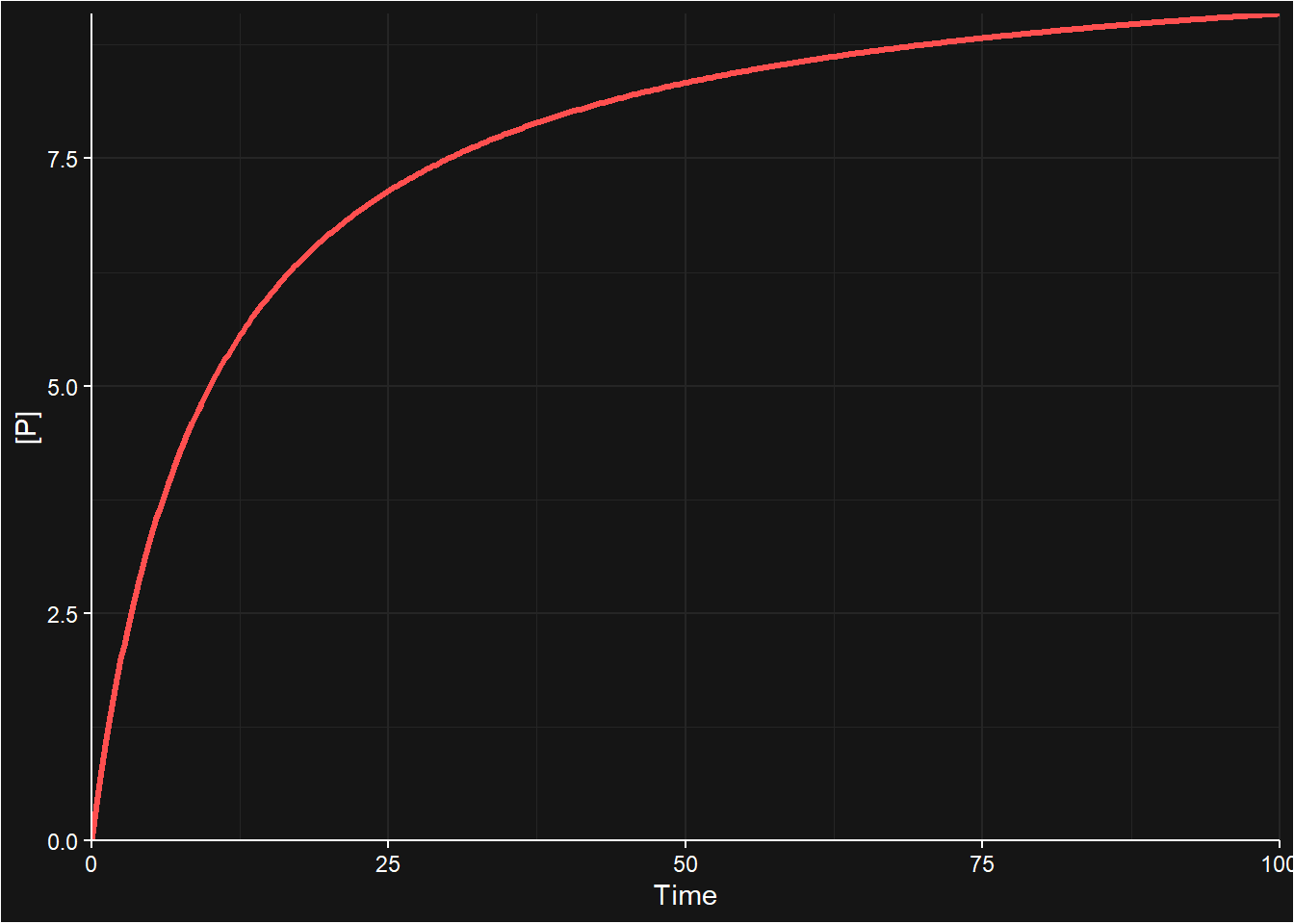
Enzyme Kinetics
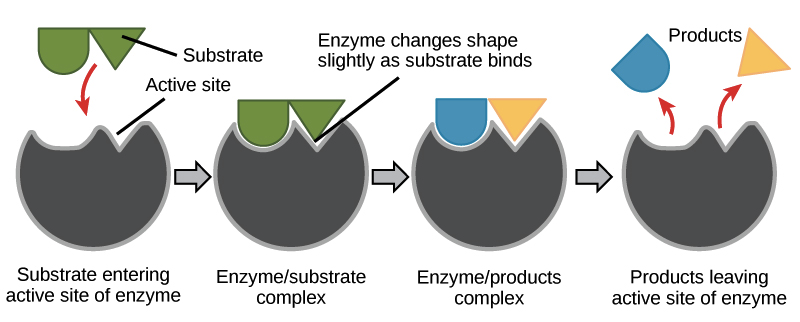
- The enzyme (\(E\)) forms a reversible complex with the substrate (\(S\)).
- The forward reaction results in the formation of a product (\(P\)) and \(E\) returning to its original state.
- Typical enzymatic reactions are instantaneous, and asymptotically approach a certain \(P\) concentration.
\[E+S \rightleftharpoons ES \rightarrow E+P\]
Prion Fibril Kinetics
- Prions form native/misfolded complexes.
- Native prions are integrated into fibrils.
- Fibril nucleation sites remain constant (2 ends of the fibril).
- RT-QuIC speeds up the process but introduces a confounding factor.
Conversion of PrPC to PrPFib \[PrP^C \xrightleftharpoons[k_{-nuc}]{k_{nuc}} PrP^{Nuc} \xrightleftharpoons[k_{-oligo}]{k_{oligo}} PrP^{Oligo} \xrightarrow{k_{fib}} PrP^{Fib}\]
PrPFib converting PrPC \[PrP^{Fib} + PrP^C \xrightleftharpoons[k_{-nuc}]{k_{nuc}} PrP^{Fib \cdot C} \xrightarrow{k_{fib}} PrP^{Fib + 1}\]
Why is RT-QuIC sigmoidal?
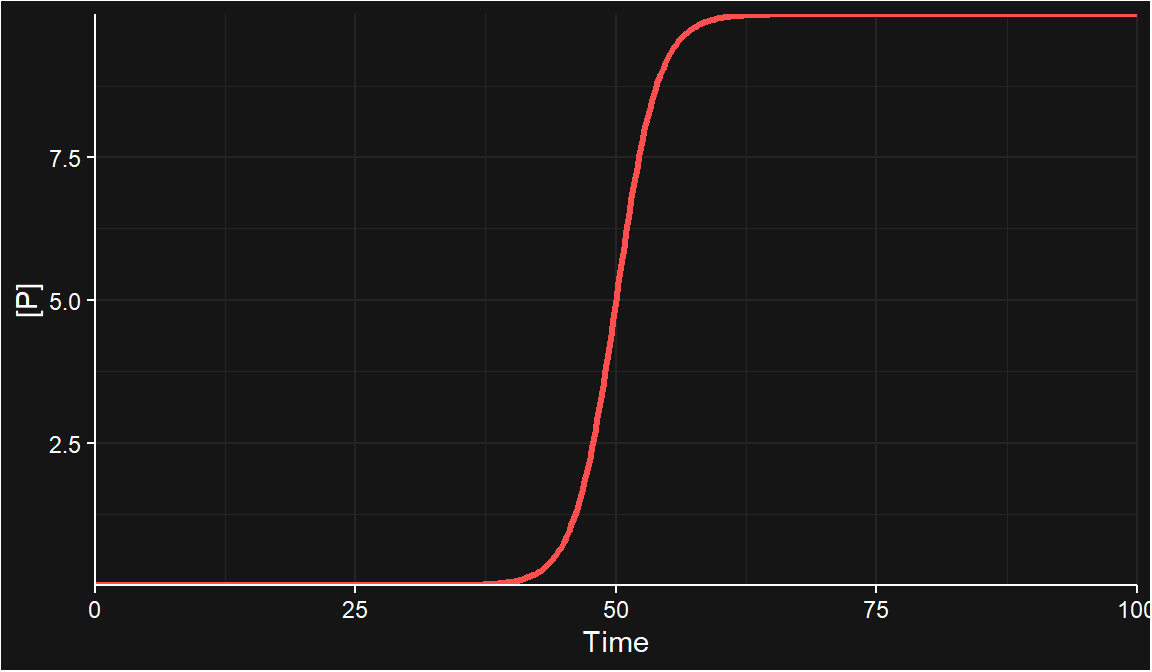
- A sigmoid would normally suggest some kind of cooperative interaction or feedback loop.
- PrP fibril formation should follow the hyperbolic curve because the fibril formation is linear.
- Why is it sigmoidal?
Fragmentation \[ PrP^{Fib} \xrightarrow{k_{frag}} 2PrP^{Fib} \]
\[ PrP^{Fib} + PrP^C \xrightleftharpoons[k_{-nuc}]{k_{nuc}} PrP^{Fib \cdot C} \xrightarrow{k_{fib}} PrP^{Fib + 1}\xrightarrow{k_{frag}} 2PrP^{Fib} \]
How do we get the rate constants?
- Alter [E] and [S] to get the \(k_{fib}\) constant.
- Alter RT-QuIC shaking parameters to get \(k_{frag}\).
- How will we characterize the reaction given that RT-QuIC frequently shows more structure than a single sigmoid?
The Double Sigmoidal Model
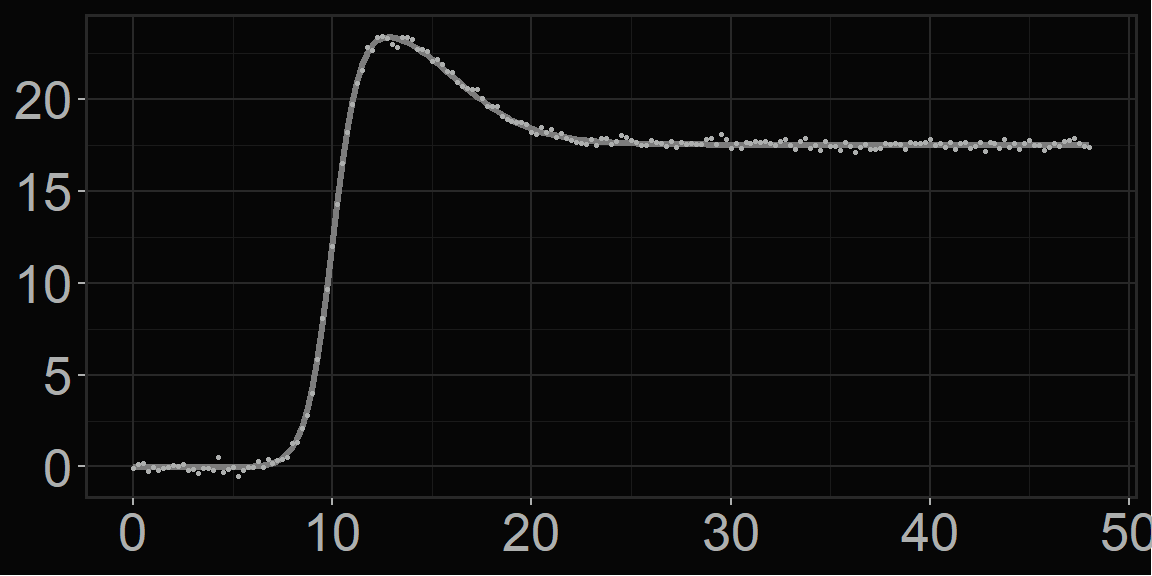
- We frequently observe a dampening effect that pulls the signal back down after the peak.
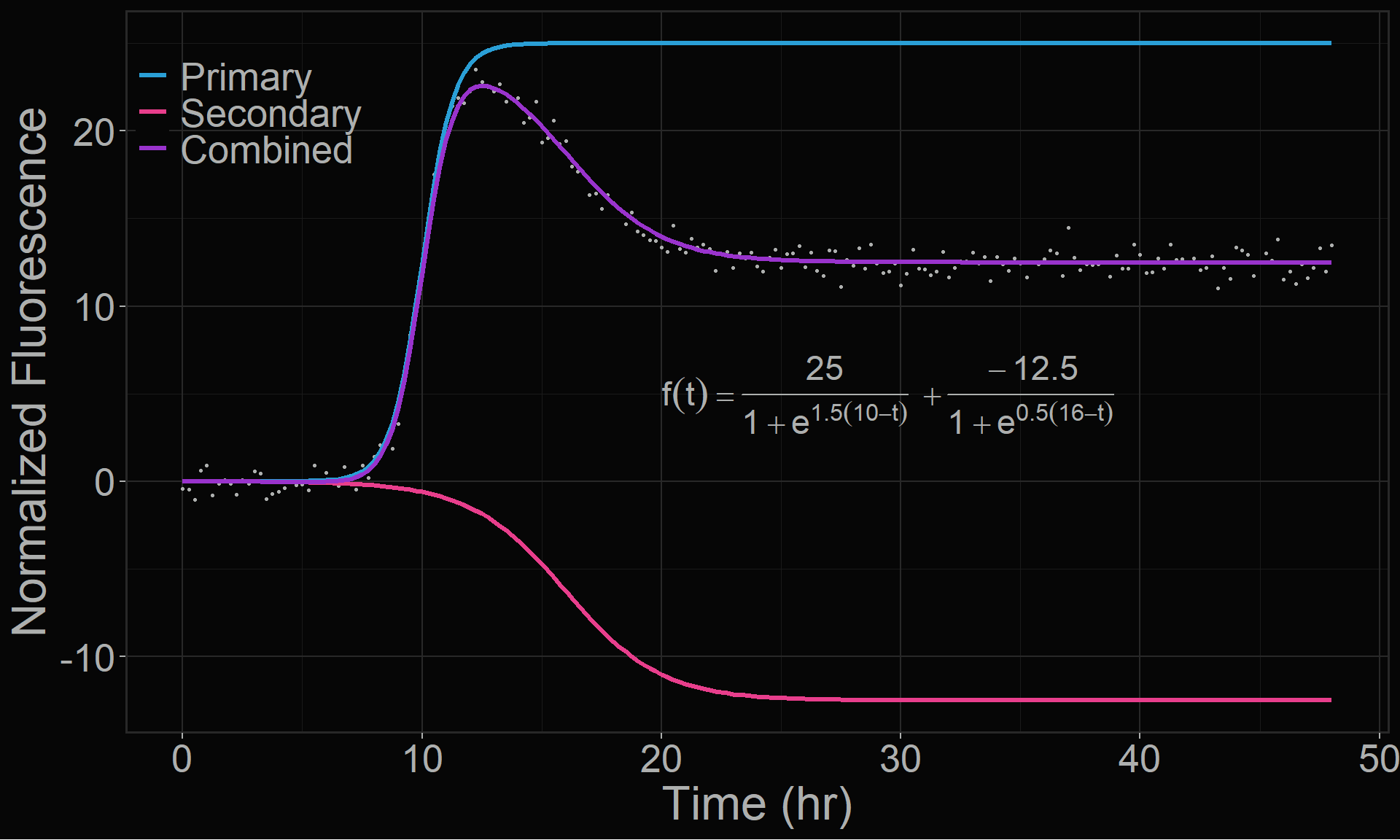
- Using a nonlinear least-squares regression, we can summarize the data as the sum of two logistic functions:
\[ f(t)=\frac{S_1}{1+e^{a_1(b_1-t)}}+\frac{S_2}{1+e^{a_2(b_2-t)}} \]
Experiment 1: Altering [E]
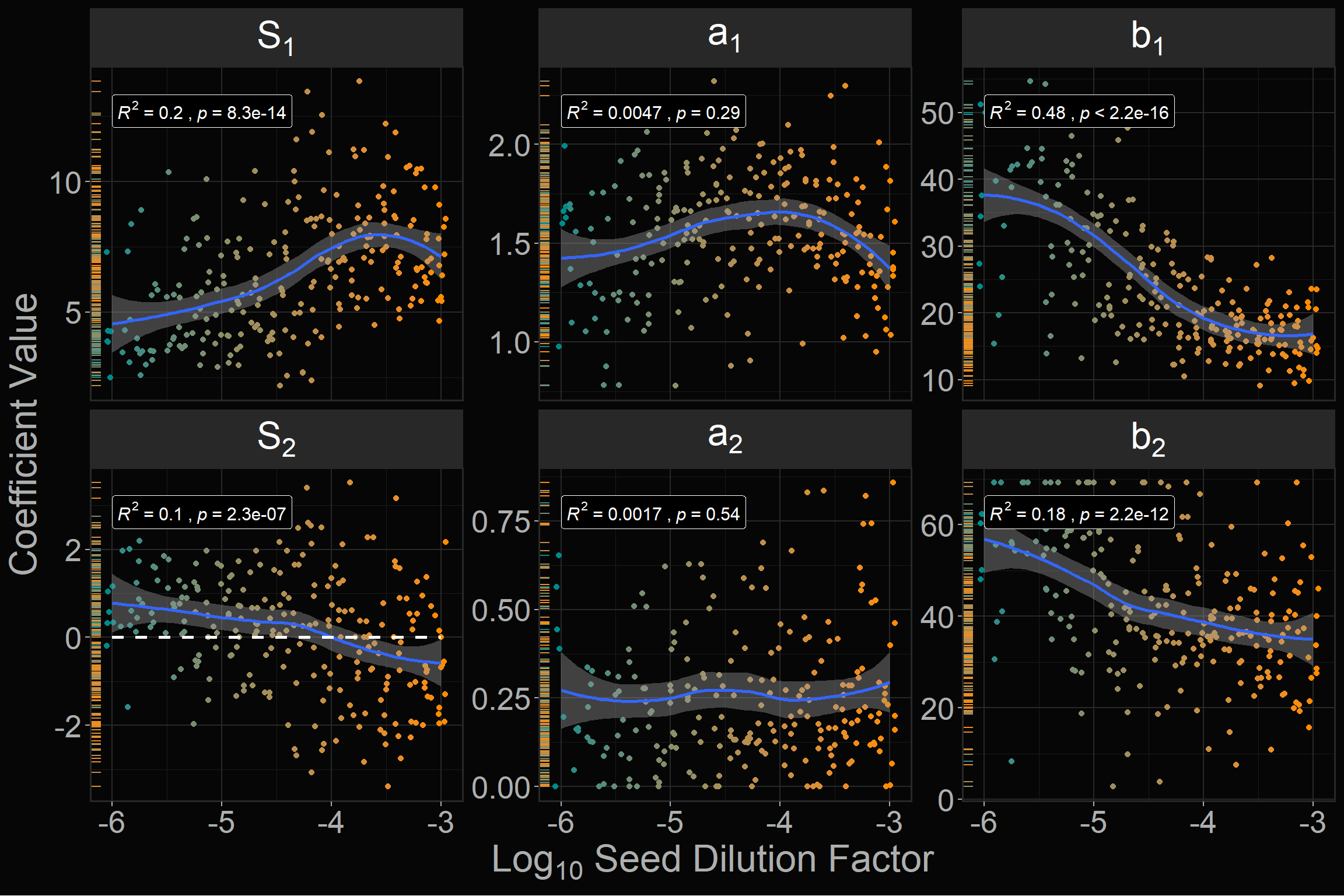
Question: Does seed concentration modulate the amplitude, timing, or inflection of either phase?
Design: Serial dilution of a known CWD-positive lymph node sample, run under standard conditions (42°C, 700 rpm, 15 min read cycle, 96 hr).
Experiment 2: [S]
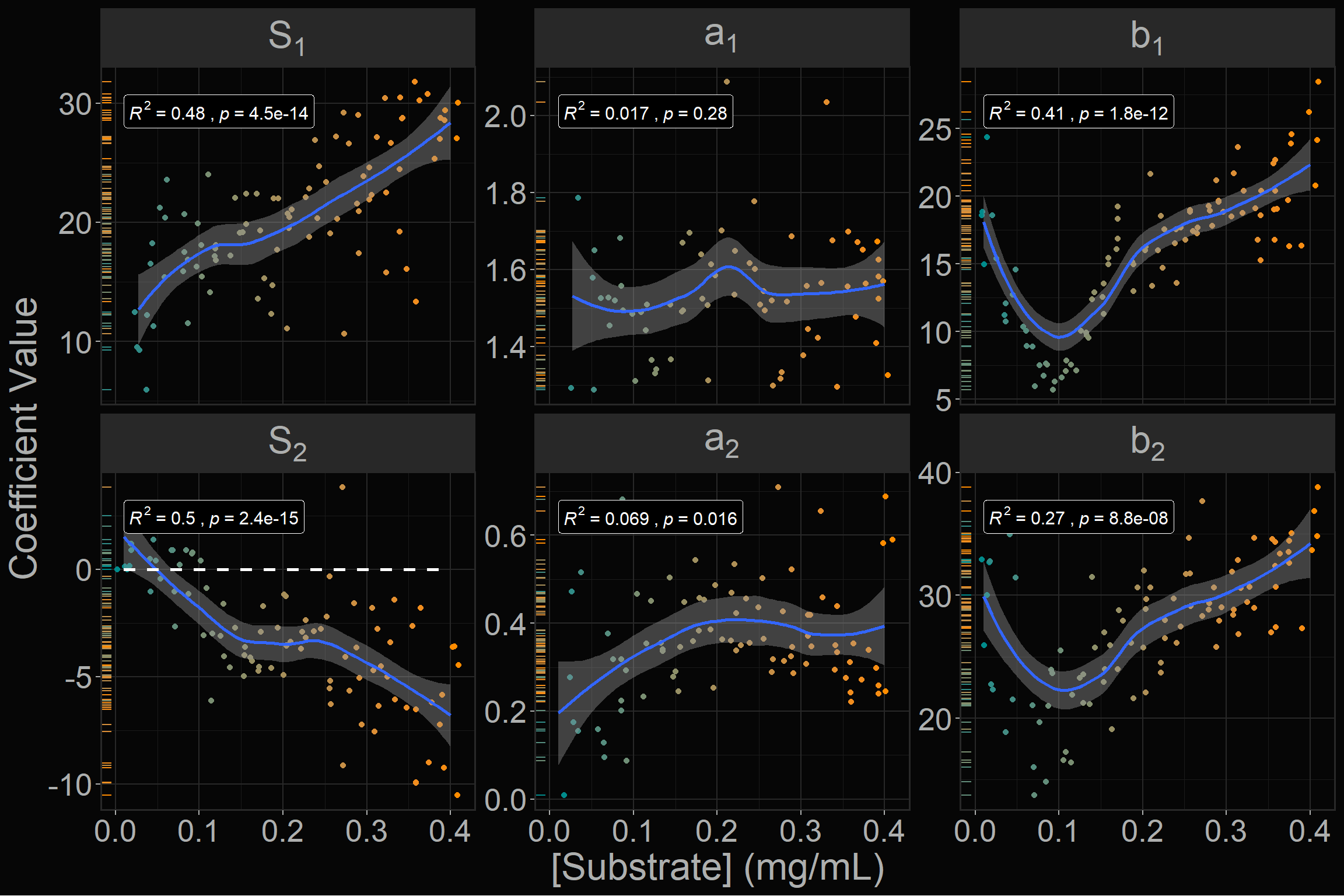
Question: Does substrate concentration modulate either phase, and does it behave like classical enzyme kinetics?
Design: Fixed seed dilution (\(10^{-3}\)), substrate concentration varied from 0.01 to 0.4 µg/µL, standard reaction conditions.
Determining \(V_{max}\) and \(K_{fib}\)
Treating \(1/b_1\) as a reaction velocity and fitting \(v = \dfrac{V_{max}[S]}{K_{fib} + [S]}\) up to the peak:
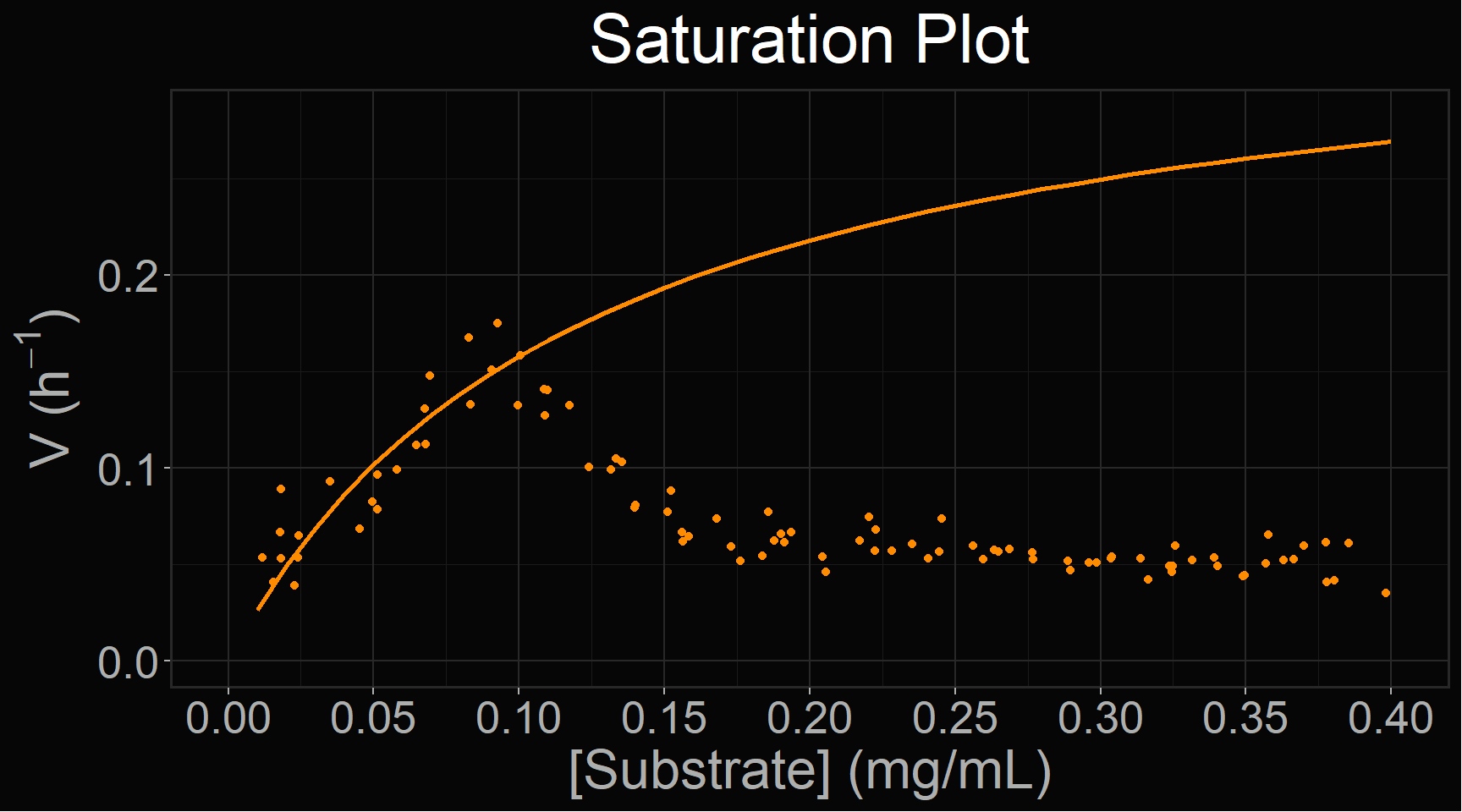
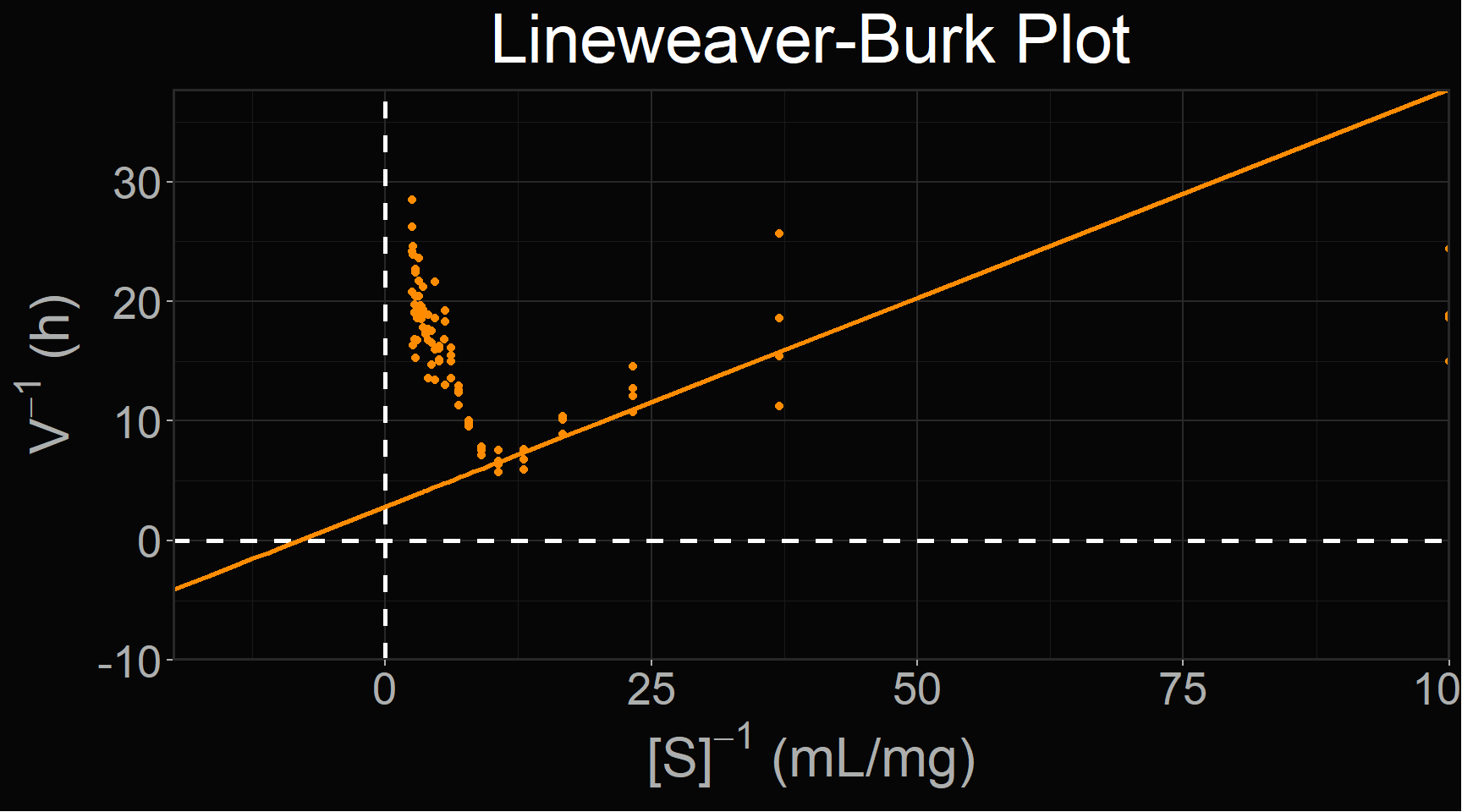
Theoretical \(V_{max} = 0.35\ h^{-1}\), theoretical \(K_m = 0.12\ mg/mL\).